

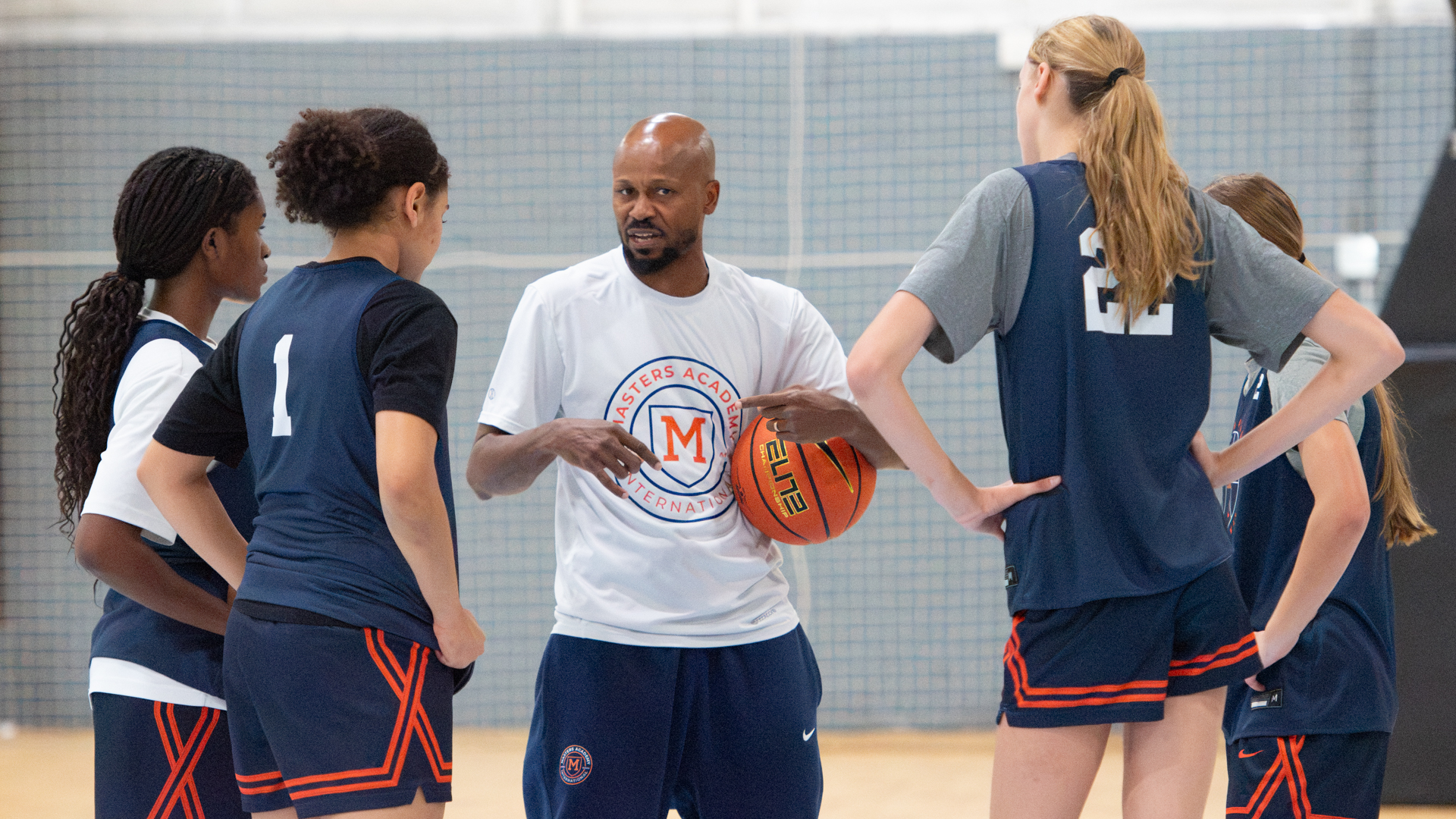

STOW, Mass. — Sean Smith, the head coach of the new Masters Academy International girls basketball program, wakes up at 5 a.m. on school days and departs his Quincy, Mass., home before dawn. “Sticks” is driving here to the school's central Mass. campus to meet his players and continue what is currently the most intriguing experiment in New England girls basketball.
By 8:30 a.m., Smith is instructing the Mavericks, which currently practice at the Mill Works in Westford, about a half-hour away. He’ll work with the players most of the morning before the team returns to Stow, where they lift, work out and prepare for their classes, which start at 1 p.m.
These nine girls and their families have invested their time, lifestyles and financial resources with the belief that MAI can deliver a prep experience unlike anything else in the Northeast.
“A successful first school year for me is: (if) I have nine or 10 kids on the roster, I need nine-to-10 of those kids to say in April, ‘I made the right decision, choosing Masters Academy,’” Smith said.
Last summer, MAI founders Peter and John Masters billed their school as the “IMG Academy of the North” and touted its athletics-centric focus as a unique offering for how students pursue sports in New England. The school opened officially on Sept. 15 in a ribbon-cutting ceremony starring Massachusetts governor Maura Healey.
In basketball, led by director John Carroll, MAI has an obvious roadmap to success on the boys side. Jason Smith, longtime Brewster head coach, has brought his legacy and parts of his program here, and MAI is effectively replacing Brewster on Nike’s EYBL Scholastic circuit. The difference is stark at open gyms, where two full MAI boys teams buzz around two courts through small-group drills with Smith quietly surveying the scene.
Girls basketball has a far more uncertain road ahead. There’s no EYBL Scholastic circuit. MAI’s gym won’t be ready until next season and the girls won’t use an alternative home site. The Mavericks have no seniors on the roster and guard Meso Nwobu is the only junior. And Smith, though a well-known trainer and former college assistant, is a first-time prep head coach. He’s also the second hire already after the program parted ways with Rodney Hill during the summer.
Nwobu is from Westampton, N.J., also Smith’s hometown, and has known him since eighth grade. Smith approached Nwobu and her mom at an AAU tournament in Chicago this summer with his initial pitch on MAI. After mulling it over, the family decided to take the plunge, and Nwobu transferred from the Hun School about three weeks before the start of the school year.
“We trusted Sticks because we've known him for so long,” Nwobu said. “We know he's a good person to be around. We put faith in him that he's going to bring us to a good place.”
Olivia Breen, one of New England’s top 2030 prospects, initially heard about MAI in the spring from her Bay State Jaguars coach, Laurie Bollin. The South Thomaston, Maine, native visited in June and was later sold on the move upon Smith’s arrival. She had known him and his wife, Chanel Harris-Smith, who was Colby College’s head coach until last season.
Breen is on her third school in three years after dominating at Oceanside High as a freshman before reclassifying. Two years ago, she joined older sister Bailey Breen and enrolled at national powerhouse Montverde Academy in Florida. That year, Breen tore her labrum and her mental health spiraled. She felt overwhelmed by the combination of full school days and massive athletic standards.
“(MAI) is very different because this is structured for athletics,” she said. “You want to be great at your sport, but you also need to be able to be good in the classroom. I feel like the classroom aspect is built so incredibly well to be able to balance athletics and academics because, I'm gonna be honest, every kid now is like athletics, then academics — which is not how it's supposed to be. So this school really supports that and the drive that most of these athletes have.”
Breen says the course workload at MAI is significantly less, and a flex block is built into the schedule for students to complete work. MAI doesn’t put tests on Fridays or have papers due on Mondays, said Carroll, in an effort to reduce stress when athletes are away at weekend games. Carroll also said roughly 800 teachers applied for 30 job openings.
Breen and Nwobu take three classes per day from 1 to 5 p.m. during the semester. Nwobu’s fall classes are pre-calc, English 11 and advanced comparative government.
“Three classes shouldn't really take up six hours, so it feels like they're more intentional about things,” Nwobu said. “I'm not as unappreciative of my classes because I know they're not dragging it out for longer, just for it to look different on a schedule or something like that.”
MAI’s 85-acre campus, which the school took over after Bose left it abandoned in 2020, does feel like a small college. The first floor below ground is for sports, including athletic recovery rooms and a massive strength training center, where both basketball teams go through workouts led by strength and conditioning coach Rich Casella. The second floor includes classrooms and a dining hall, and the third floor features housing that looks a lot like large college dorms.
Nwobu admitted she is a natural homebody and was worried that she’d want to go home every weekend. But she’s acclimated to boarding life surprisingly well.
“It honestly exceeded my expectations, because I've heard a lot from people who dorm at other places (and) they're like, ‘Oh, this is a jail. I hate it here.’ Stuff like that. And I really don't feel like that here,” Nwobu said.
Breen feels the dynamic among her peers is different from her previous schools.
“It’s a first-year school, so no one's greater than anyone else,” she said. “We're all learning this for the first time, and that makes the school so special. We're creating bonds because we all are new.”
Still, though student life has been a breeze so far, the training schedule is a significant adjustment. Breen referenced the 712 hours in added training time that MAI athletes expect to receive as both a positive and a steep learning curve.
“It is a very intense schedule, and I don't really think your body can prepare for it. Especially on a basketball court, the wear and tear of just going up and down, up and down,” she said.
MAI has already begun competing at the Rose Classic, the Smalling Tournament in Canada and additional local scrimmages. Their relationship with NEPSAC programs is… mixed. Some coaches have respectfully declined playing them and others have outright scoffed. But MAI does have five NEPSAC opponents on the schedule: Newman, St. Andrew’s, Hoosac, Darrow and Hamden Hall.
“I'm thankful that those programs didn't really look at us with any sort of ambiguous feelings,” Smith said. “They understood that in theory, we're building out to be a national program, but right now, our program’s still in its infancy. We haven't arrived yet, so we need work just like everyone else.”
Carroll has been unapologetic in labeling MAI as a disruptor to the traditional principles of New England prep schools. He’s unflinching regarding NEPSAC’s wariness of his teams.
“The mission that I've always had is to make sure New England shines as bright as possible, and then whatever we can do to bring the attention nationally with colleges to our region, the better. So if that's your mission, you’d hope other people would align with it,” he said. “What I've learned is that other people have missions that they find more important, and we're not going to schedule them, and that’s their loss. But there have been some obstacles in terms of getting alignment with that mission.
“For me, I'm always kids first, program second, school third, conference affiliation fourth, and I think what we learned is there are a lot of programs in New England that are conference first, school second, program third, and then kids fourth. And that's been disappointing to learn.”
MAI made a statement by adding Angelyn Almonte in the final days before school began. The 2029 guard was previously a star at DePaul Catholic in Wayne, N.J., and already holds offers from Rutgers, UCF, Syracuse and more. Almonte and Breen are the two top prospects on the roster and happen to be close friends. Breen was a key voice in convincing Almonte to come to MAI; they’re now roommates.
Beyond those three, MAI is about evenly split between New England recruits and New York/New Jersey transfers. The roster has already drawn the attention of college coaches. Providence and New Hampshire, for example, attended MAI’s open gym on October 20.
“I think that college exposure is the main reason why a lot of kids are here. There's also the getting-better aspect, but just being able to get more exposure in front of coaches,” Nwobu said. “We're playing at a high stage, so a lot of higher-target colleges are able to come and watch as opposed to other schools. And I feel like my coaches do a lot more extra, just to talk to coaches (and) build relationships with that. So that's really the main thing that is on my forefront, because as a junior, I'm trying to get as much interest and offers and things like that that I can.”
But college scholarships aren’t guaranteed at any school. And the price tag for attending MAI is on par with college tuition itself. Financial aid notwithstanding, non-boarding high school-age tuition is $65,500 for the 2026-27 school year and $79,500 for boarding students. Do players feel pressure?
“Maybe by January it'll start to feel a lot more pressure-like,” Nwobu said. “But at the start of the season, it doesn't really feel like that much.”
At that open gym, Smith pushed his players to move the basketball quickly and avoid selfish decision-making. He spoke in the post-practice huddle about sacrificing and trusting teammates. It’s an apt microcosm of MAI’s first school year.
Smith and the players seem to have a shared understanding. Above all else, this first season is about building chemistry with a roster that, in theory, could return everyone for a second stint. Breen believes that by her senior year, MAI will be competing in Chipotle Nationals — something no New England school has ever done.
Before then, the Mavericks will hit speed bumps as athletes learn how to play, live and learn together in a new environment. It’s Smith’s job to keep his players and families trusting the process.
“I have a job to do, and I feel like no matter what the sticker price is, I'm worth it,” he said. “I try not to think about (the financial investment). There's just certain things you can't put a monetary value on. I understand that most people don't have an infinite amount of resources. Everyone's resources are finite. So to that end, I trust that the parents do their due diligence and get an understanding of what it's going to take for the student-athlete to be a part of this. And if it works out for you, then it works out. But if it doesn't, then I understand that also.
"We don't try to make it about the money — like, ‘Hey, this is the institution. You understand, you know what it is. If it works for you, let's move forward.’”