

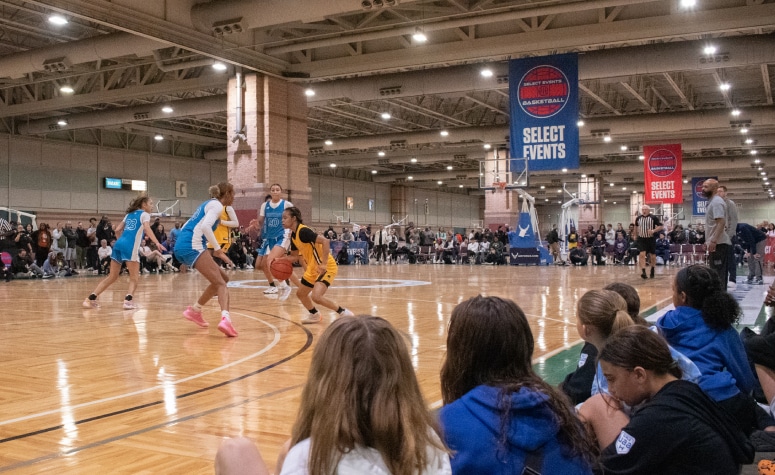

At the competitive youth level, basketball is emphatically a year-round sport.
The AAU ecosystem has been churning since late March, mere weeks after school teams secured state championships.
Travel basketball is a complicated, chaotic world. Instead of school bus rides, teams bond in hotel lobbies and airports while trekking around the country to play in front of college coaches — and possible scholarships. The competitive fire remains stoked all summer long.
If you’re a fan of local talent, today’s AAU scene is required reading, viewing, and social media scrolling. Here’s what I’m anticipating as the heat turns up.
Who are the local AAU teams to watch on the elite circuits?
Four programs consistently stand out as the powerhouse shoe circuit squads in New England: Expressions Elite (Nike Elite Youth Basketball League/EYBL), BABC (Adidas 3SSB), Mass Rivals (Adidas 3SSB) and Middlesex Magic (Under Armour). Their top 17U rosters are loaded with future Division 1 stars and potential NBA prospects.
BABC started on fire, with a 15-4 record entering June in major showcases according to The Circuit. One of those losses was an 80-76 defeat to Expressions (16-8) in the GymRat Live Championship on April 21. Middlesex Magic (20-4) has only lost once on the Under Armour circuit, but has split two games against Rivals (11-8). All four teams are capable of hanging with most squads around the country.
On the girls’ side, the Mass Lady Rivals (Adidas 3SSB) and Bay State Jaguars (Under Armour) compete at the top level of national shoe circuits. Select Events, an independent organization, has developed two circuits that have gained national steam in Select 40 and Power 24. You’ll find MCW Starz (Mass.), Maine Firecrackers, and iBelieve Elite (Conn.) under Select Events.
Which programs on the secondary circuits will stand out?
Dozens of quality AAU programs compete on competitive circuits outside of the major shoe brands and Select.
No New England girls teams play in the Nike EYBL, but several fall under Nike’s secondary EYCL (Elite Youth Champions League) this season, including large, established programs like the Mass Huskies and New England Crusaders.
A quick hat-tip to the Honey Badgers, a tiny program based out of North Attleboro, Mass. They only field one team and will fold after this season. Despite injuries and a small roster (in numbers and size), they’ve hung tough, with a 5-5 EYCL record to lead the New England squads.
Under Armour also has a secondary circuit, UA Rise, with programs including the Massachusetts-based girls team MT Ducks Elite. PUMA has started its own PRO16 league which includes the boys program Rhode Island Elite. Hoop Group, another independent event organizer that focuses on the East Coast, runs a Hoop Group Showcase League that features several teams around New England.
In short: There’s a lot of good basketball beyond the most well-known circuits.
Big names making big college decisions
Two of the best New England high school basketball prospects in recent years are approaching major college decisions.
AJ Dybantsa (Brockton, Mass.), the consensus top boys player in the national Class of 2025, has made three unofficial college visits as of June: Auburn, USC, and BYU. He’s currently focused on AAU play with the Oakland Soldiers and recently announced his transfer to Utah Prep for senior year.
Dybantsa has said that he won’t rush a decision, and plans to continue visiting schools well into the fall. But the recruiting world will pounce on any update, so expect rumors to fly.
Kaelyn Carroll (Dedham, Mass.) is currently ranked 30th in the 2025 class by ESPN, and could be the highest-ranked New England-based player since Caroline Ducharme (fifth in the 2021 class). Carroll is juggling more than 40 offers. She expects to make a decision towards the end of the summer, following her final campaign with the Bay State Jaguars.
Over the next few months, we’ll see hundreds of local stars commit to college, but Dybantsa and Carroll are the headliners.
Which breakout stars will seize the summer?
The 2025 class has the brightest spotlight right now, but the subsequent high school classes are also ready to put their names and games in front of college coaches. AAU basketball is a great opportunity for player development — but the “exposure” buzzword has turned it into the giant industry it is today.
In July, the frenzy reaches its peak. This month contains the last “live periods” — specific windows when Division 1 coaches are allowed to scout players in person — on the recruiting calendar for boys (July 11-14, 19-21, and 23-25) and girls (July 12-15, 19-22). The marquee circuit tournaments of the summer take place all around the country in these windows.
It’s a stressful, exciting time for everyone involved. But as an outside observer, I love scrolling social media in the days following a live period window to see players announce verbal offers, or scouting services that take note of standouts. A well-timed performance or a summer of hard work can change a kid’s life in the form of a scholarship.
How many reach-in fouls will get called?
AAU basketball is such a different world from scholastic play. The pace is faster, the offenses are typically less reliant on sets, and players can get away with a lot more by asserting their physicality. Across all levels of play, and between boys and girls teams, basketball is quite the contact sport in the summer.
Want to stick your hand in the cookie jar and go for a steal? There’s a good chance you get away with a reach-in foul. Battles on the glass can get intense — and if you’re longing for the 1990s era of basketball, you might be able to sneak in some hand checks.
This isn’t a slight at any particular official or organization. It just seems that across the AAU landscape, for better or worse, the boundaries of physical play have been stretched. That matters when the rapid-fire weekends of multiple games per day start to stack up.