

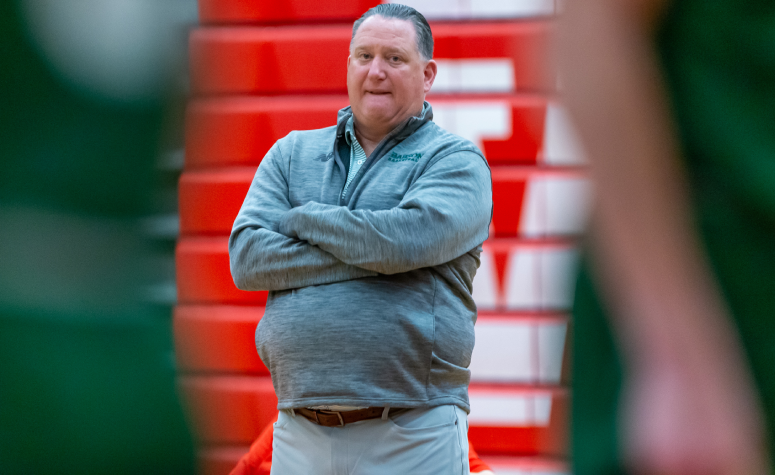

For the last three decades, Stephen Brennan has overseen one of the most successful Division 3 men's programs in New England.
Brennan has won 519 games as the head coach at Babson, including the 2017 national championship. The Beavers have recorded 24 winning seasons under Brennan’s leadership, including 15 consecutive years dating back to 2011. Brennan is the winningest coach in Babson history and has led Babson to 12 NCAA Tournament appearances.
Brennan has seen a lot of change since he took over the Babson program in 1995. With all his experience and success, we thought he’d be the perfect subject to begin our Recruiting Insider series. In our chat, Brennan discussed the evolving recruiting landscape, his pieces of advice for prospects and their families and much more.
Let’s dive in with Brennan on a variety of questions and topics.
This interview has been lightly edited for length and clarity.
When is a good time to fully dive into the recruiting process?
“The biggest thing for them is (to) understand what their criteria is to even look at a school. All these schools are going to call you, but the more important piece is you need to think about what you want out of a college, and part of that is location, opportunity to play based on the roster — you have to look at how many guys on the roster are currently playing your position and putting up numbers — and then curriculum desired. And then some guys said the other day, I really like those two leagues, those are leagues I want to play in. So I think they can start doing their homework at the beginning of their junior year and a number of schools are already going to be talking to them or even texting. But then, I think what happens is that now, if you come visit me now, which a lot of kids do, a lot of kids visit between now and June and then take a second visit in August after the live period, or they’ll be doing their first kick the tires visit August after the live periods are done because then they kind of know who’s recruiting them.
“The thing is, at the high academics, it’s just a matter of we have to get your transcripts at the end of your junior year to pre-screen you admissions-wise. Those are all kind of the little tips that make it easier to understand whether you’re even a viable candidate. We can love you as a basketball player, but for us, if you don’t have the right combination of rigor and math classes, you’re gonna be a maybe or a no really fast.”
What have been the biggest shifts in the Division 3 recruiting landscape — maybe in the last 10-15 years — from your perspective?
“I think you can take COVID as a separate issue where a lot of schools were getting the grad transfer situation, so that’s kind of gone on. But now, we’ve always been a school that’s been favorable for transfers. We’ve never been to the NCAAs without a transfer. So I think a lot of people say, I want to get a job and study business, so I’m going to look at Babson, whereas when they’re 18, they might not have that feeling. And then we’ve had success, so they want to be part of that, too.
I think the biggest trickle-down is, it used to just be that kids would switch AAU teams, you know? For whatever reason, whether they’re not happy about playing time, it’s not the right style, we don’t feel there’s enough exposure with you, I think all those reasons come into it. And then now, the transfer portal and NIL have created more transfers for even D3 colleges. Like we’re still talking to transfers much more so than we did before COVID, because there’s more availability because they all go in the portal. A kid’s like, 'I had a good year, I’m going in the portal.' For some, it translates into a scholarship, but for a lot of them — I talked to a kid, I won’t say the college, but he got into an amazing college and decided to go to another school. That coach retired, now he’s at another school and now he’s not happy with his playing time, so now he’s on his third high-academic school, which never used to happen. I think there’s just a proliferation, the idea is 'Hey, there’s more out there, I'm going to transfer. I’m not getting what I want out of this situation, so I’m going to go.' For us, we’ve had almost no transfers because they want the outcomes of Babson.”
Has that changed your recruiting approach at all when you go into a live period or showcase event?
“You obviously want to get studs whenever possible, but it’s not like we can go into any of the live periods and say well, we want a 6-10 center, we want a 6-6 wing who’s a three-level scorer and we want two point guards who use ball screens at an elite level. You’re not getting your wish list, but you’re looking at what your roster is going to be in the next year to two years and forecast out what you need.
“I think when you’re thinking about roster construction, yeah you’re going to have needs, hey we need to bring in guys who can handle, we need to bring in guys who can make shots … and you want to play, at least at our level, play with like a 6-4 to 6-7 forward who’s versatile, plays in and out and have the five out because everyone seems to play five out now, or are you going to find that 6-10 kid, strong as an ox who’s really going to stretch defenses and force double teams? Part of it is who you can get, both academically, interest and financial aid or financial aid, and then when you look at that, where does it fall? … The final decision that kids make is really interesting because you never know what the final rationale is.”
What's been one big change in the recruiting landscape over the last few years?
“I think you look at the landscape, and the biggest change — you hear Rick Pitino (saying) 'I’m not looking at high school kids.' But the funny thing is, we were talking to a kid who was 6-10 at one of the NEPSACs and we’re thinking, we’re gonna get this kid, right? And Bill Self ends up calling the next day and Bill Self offers this kid because it’s not going to cost him any NIL money, so this kid’s basically going to be a blocking dummy and be one of the 15 scholarships with no NIL, but he gets to go and be on Bill Self’s bench. I think one of the things that’s happening is, because they’ll have the schools that are in for the 15 scholarship limit, they don’t have walk-ons anymore. So they just scholarship the last couple guys on the bench to just be there for extras at practice or injuries or whatever and they’re not Big Ten, Big 12, ACC, Big East level, but they’re kind of handcuffed where if you don’t opt in, then you can have a bigger roster. So that’s a big change. Because that kid would have been a D3 kid.”
What are the benefits of going the Div. 3 route that may not exist at other levels?
“I think the biggest thing is just, going back to the last question, I would tell kids to go to some D3 games to get an idea of the level of play and the level of skill. There’s different levels of D3, too. There’s kind of the elite, elite teams that have incredible talent with guys who can play up but they picked the academic experience and it’s a good brand of basketball. I just think there’s a misnomer that if you play high school basketball, you can be a D3 guy. And — maybe. But when you get down to the brass tacks, less than two percent of all high school basketball players still play college basketball. So, it’s still a pretty exclusive club. I think that’s important to put out there. It’s still very competitive to get on a D3 roster. One of the other things that’s going to happen, you see (Saint Anselm) drops down, that’s just more guys potentially taking spots. Obviously Anna Maria closing pops their kids into other schools, but also, their end-of-the-bench guys might be done, because there’s not another opportunity at another school, so there’s definitely new forces in the marketplace.”
Do you think kids might be putting too much pressure on themselves to be a Div. 1 or scholarship player when they can still get an amazing opportunity at a Div. 3 school and chase their dreams from there?
“A lot of these kids are getting coached to hold out, hold out because you’re a scholarship guy. Well, there’s less scholarships available because they’re going to the kids in the portal. So you’re holding out for a scholarship (when) every school is trying to get a kid that’s a higher level or a ready-made kid to plug and play. … There’s different paths to it. You can almost use a Division 3 as a prep situation to get high minutes and opportunity to prove yourself and transfer out. That’s a different route that more kids are taking. 'Hey, you know what, I didn’t get the situation I wanted, so I’m going to go to a good D3, I’m gonna start, I’m gonna be impactful and then I’m going to look around.' …
“I just think everybody still wants a scholarship because it’s basically a badge of honor and courage and I made it and I put the time in. So I think sometimes the decision-making is poor because they let that be the driving force as opposed to, 'hey, I want to go some place I can play right away.' If they’re waiting on a scholarship to give it to you, it’s because they have guys ahead of you on their list, or they’re waiting for the portal to shake out.”
What are your biggest pieces of advice to recruits and their families as they go through the process?
“One, you’re in control of the process. You don’t owe any of the coaches who are texting and calling you a visit just because you’re a nice guy. If you’re interested in that school, great. Pursue it and learn about it and there could be more than one match that fits your criteria. So, understand that if you know you’re never going to apply to that school, don’t get forced just because someone keeps saying you have to come visit, it’s better than you think. It’s very flattering to get the interest, but it’s also like, you have one shot at this senior year and you want to have a great senior year or reclass year where you enjoy your time but also can compete at the highest level for your current team. If you’re interested, great, keep them on the list. If you know you’re never gonna go there — like if you want to be a doctor, you’re not going to Babson — so just politely say, 'I’m just not interested.' The coach might say, 'can I check in in a month?' OK, that’s fine, but the pitch is probably not going to change. So one, be in charge of your own process, don’t let people eat up your time because you only have one take.
“Second would be, really look at teams’ rosters and stats to make sure either you fit how they play — styles are important — and try to get to a practice. Try and play pickup with their guys just to see levels. People don’t understand how good some of these kids are in D3. The most important thing is you want to spend time with the freshmen and sophomores (on the) current team because that’s the kids you’re going to be with for two or three years of your career. Are those guys you want to spend five months, six days a week with? And then obviously, are the schools meeting your criteria for location, for curriculum, for outcomes? One of the outcomes that people want to talk about is, I want to play overseas. Great, OK, well we’ve had a number of guys do that, we can help you with that. Some schools haven’t.
“I always tell people, the one thing I always tell a recruit is you have to make me play you. If people are promising you playing time, or you’re going to start, I find that difficult to accept because how many other guys are they saying that to? Feel like the coaching staff is going to meet your needs and be supportive and build relationships.”
What does the ideal prospect at Babson look like?
“You have to have the right quantitative background. You have to have at least pre-calculus or we’re out the door, and the school itself says A-minus. We’re test optional, but the average SAT was 1485. I don’t know if there’s a typical … I just think you’re taking rigorous classes, honors and AP, and you’re doing B (grades) and above, hopefully closer to A, and you’re at a school where they’re taking the toughest classes they offer, because they want to see that.
“As far as player goes, we love two-way guys who have versatility. We’re going to need you to play defense and get on the glass and win 50-50 balls. We want guys who want to play hard, compete hard and love basketball so that they’re going to develop, with our help, on and off the court to be their best selves. I think with the 3-point line, you have to find guys who can make threes. We still want to score twos; I don’t think we want to just be firing every single time down because we want to share the ball. I think it’s like, can you find the best shot for your teammates? Can you make open 3s and can you get downhill to play off two feet to make other people better? Or, as a forward, can you be a cash register guy on defense and be able to guard bigger, stronger guys, switch on to smaller guys and be a factor on defense, not a liability? …
“At the end of the day, you want kids who play hard, who compete hard which I think is different than playing hard and ultimately understand that toughness wins. A lot of games are lost because you’re just not that tough. You’re soft and you’re not willing to be physical. Look, it just tends to be that referees allow physical play in a lot of games, so you have to be able to make plays through contact and then make shots through contact because it’s not perfect.”