

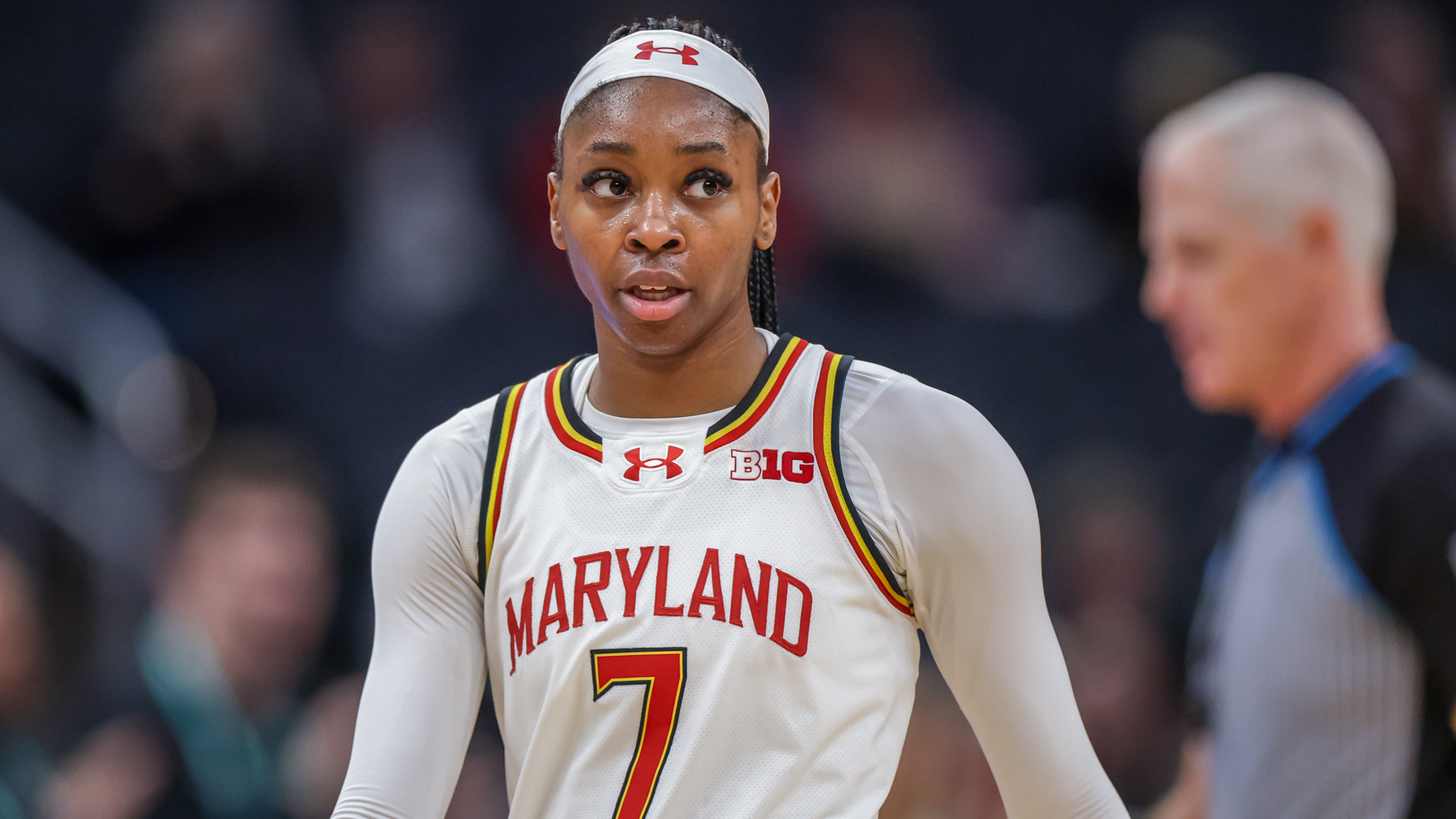

Basketball has taken Oluchi Okananwa to places she never expected.
It has led the Peabody, Mass., native to her current starring role on Maryland, ranked 20th in the preseason AP poll. It could lift the senior guard to the WNBA, where Okananwa (should she declare for the draft) is a projected first-round pick.
And recently, her basketball journey has included Capitol Hil.
Okananwa, one of college basketball's premier stars, is also the interim president of the United College Athletes Association (UCAA), a union making a large-scale push to bring collective bargaining to college sports. She and the UCAA are challenging the Protect College Sports Act (PCSA), which passed the U.S. Senate on Sept. 28.
Okananwa has participated in Instagram Q&As with Senator Chris Murphy from Connecticut. She considers Representative Lori Trahan, from Massachusetts, a key teammate in the cause. She has gone to D.C. and met with members of the AFL-CIO.
Okananwa competes for Maryland with a fire that powered her to All-Big Ten First Team and All-Defensive Team status last season. That same energy radiates when she discusses the injustices she perceives around college athletes' compensation.
"I think the frustration comes from cutting out the student-athlete," she said. "It really does enrage me, just knowing — because I'm obviously I'm a college athlete — just knowing how big of a deal this is in my life, and just how everything else revolves around it. It hurts seeing systems and people who are said to be for us, Who are said to protect us, not want to have us as close to the fire. There's a difference between projecting my voice, projecting what it is I believe, and then actually being heard."
Okananwa didn't have one lightbulb moment that spurred her to action, but her outrage towards the PCSA and those in power grew over time. A former teammate connected Okananwa with the UCAA and the organization further inspired her to get involved.
Okananwa is passionate about the implementation of collective bargaining in college sports because she believes it will properly regulate the professional reality of this level.
"This is now, whether we want to accept it or not, a professional league," she said. "The only thing different, of course, is just that we're going to school. But with our training times, we're dealing with contracts and agents, and you're thinking about all the different things that's eerily similar to professional athletes, and because of that, we need to set up such a structure — a professional athlete-like structure."
The PCSA, officially proposed by Republican Senator Ted Cruz and Democratic Senator Maria Cantwell, was followed by an onslaught of public marketing by prominent names in college coaching (such as Nick Saban) and major endorsements by President Donald Trump, the NCAA itself, and many more.
The bill has several facets, including a new one-time transfer rule, regulations on NIL deals and caps on revenue-sharing figures, a cap on five percent fees for agents, and granting the NCAA limited antitrust exemptions to help enforce transfer and eligibility rules as well as allow power conferences to join together on media rights deals.
Okananwa explained her primary frustration at two angles. First: the revenue-sharing cap that would start at $21.6 million, with an additional retention pool of $22.5 million available for schools to try and keep their current athletes. She believes this unfairly caps earning potential for athletes, especially when the bulk of the revenue-sharing dollars will undoubtedly go towards football at FBS schools. The PCSA caps what athletes can make, but critics say it does surprisingly little to cap program spending in other areas, including paying coaches.
"Football plays the part in all of this. That's just the truth with it. And I think it's very concerning where we look at the demographic that predominantly benefits compensation-wise from everything that's going on — African-Americans — and now there's a push and an urge to cap things, to regulate things. It's like, wait a minute! Why should we be trying to regulate and cap hard-earned compensation?" Okananwa said.
"All of us athletes put our bodies on the line daily. We put everything into our sports, literally everything. And for years, NCAA conferences (and) coaches benefited off of it. We're talking about billions of dollars."
Okananwa repeatedly mentioned that through the PCSA, Congress and the NCAA have found a way to enforce rules on athletes without needing to negotiate with the athletes themselves. She wants regulations to hold athletes accountable. She agrees with some parts of the bill, but feels has been pushed through without a fair representation of the athletes.
"I think a big misconception too is that in the Protect College Sports Act, there are things that we also want," she said. "That's not at all the point. The point is, with collective bargaining agreements, you have that legal backing of 'Hey, I know this is what can come against me if I do X, Y, and Z, but I also know if I do X, Y, and Z, you must do this. If you do that, then I can do this.' And I just feel as though what so many people are looking for is clarity and stability — and what more stability could you have than having an open conversation with all parties and coming to terms that best hold everyone accountable?"
Okananwa emphasized that she's fighting for the next star athletes after her; she has, at most, two years left in college basketball. But she's a prime example of a star basketball player who has enriched her life off the court.
Fashion is central to Okananwa's public image; she started the "Styled by Luchi" series when she played at Duke before transferring to Maryland as a junior. The Terrapins open their season in Paris on Nov. 2 against top-ranked South Carolina, and Okananwa collaborated with HerTunnel to explore the city's fashion scene during the trip.
Okananwa grew up watching Project Runway and daydreaming about fashion with her older sister, Chinma. Now her wardrobe is part of who she wants to be as a role model.
"I don't want to just limit it to women's basketball players. But I think, any woman in general who's entering a career that has younger girls kind of looking up to them — it's really important, just in terms of the fashion space, to get across to them to be who they are, be who they want to be, (and) how you can truly express yourself through your outfits. And most important: you can have fun with it," Okananwa said.
Okananwa is the youngest of four siblings. Her parents, Anthony and Patience, are from Nigeria. Okananwa suited up briefly for the Nigerian national team during a training camp tour in the United States and is hoping one day to visit the country.
Her Nigerian upbringing also instilled a profound tie to her Christian faith. Today, Okananwa incorporates daily Bible reads into her life, listens to Christian meditation music and attends Sunday church. Okananwa believes the most pivotal twists in her basketball journey have coincided with times she's grown her faith.
"I say it all the time: I'm not really running my life, to be honest. It's 100 percent (God)," she said. "And it's that's truthful because so many things — in terms of the way things have played out, opportunities that have come to me, X, Y, and Z — I haven't sought out any of that. It's truly just been him introducing it into my life when he feels like it's right."
Some of those turning-point moments include seventh grade, when Okananwa departed her first love, gymnastics, and committed to basketball. After playing her freshman year at Peabody and then two years at New Hampton, Okananwa hit another landmark chapter during her final AAU season with Mass Rivals. At that point, she went all-in on seeing where basketball could take her — and flew up to a top-30 national ranking, starred as a senior at Worcester Academy and committed to Duke.
Now, Okananwa feels called to the fight over the future of college sports.
"(PSCA supporters say), 'We're for the the student-athletes.' OK, so then get us involved. So then, let's sit down together and come up with a college athletics framework that holds all parties accountable," Okananwa said. "I think that's something that we want to stress so much. We are not trying to get involved so that we can give ourselves a free-for-all. Not even close.
"We want to be held accountable for our actions just as much as the coaches to be held accountable, the schools to be held accountable, the conferences to be held accountable, the NCAA to be held accountable, and that comes from a legally binding contract that is a collective bargaining agreement."