



At a time when women's basketball is booming and high school girls basketball is bouncing back, New England continues to get left behind.
The latest annual participation survey from the National Federation of State High School Associations (NFHS) counted 362,382 high school girls basketball players nationwide during the 2025-26 school year, an increase of 6,142 from the previous tally. It's a notable change in the context of the last 10 years, when the country's girls basketball participation has nosedived from more than 430,000 players. You can find the full survey here and the organization's press release here.
New England, however did not help the cause. After a slight uptick in 2024-25, the region's girls basketball pool took another hit last year, with the NFHS survey listing just 16,546 total participants. Across the last five surveys, New England's participation has declined roughly 9.51 percent. Since 2004-05, New England has lost more than 28.5 percent of its girls basketball population.
Let's get into some more takeaways from these important yearly check-ins.
A state-by-state look
Four of the six New England states saw their participation totals decrease in the latest survey. Before we get to the table, I want to be clear that these numbers do not include NEPSAC and other prep schools. The states report these totals, so it only includes their state association public and private schools. We'll touch on this later in the breakdown.
The first thing to note is, clearly, we have some data collection issues to sort out. I don't think Vermont suddenly nearly doubled its participating girls basketball players (and also doubled its participating schools) in the last year after having the exact same count in the prior three years. I would almost ignore their state totals. The only meaningful numbers to me are this year's improved tally and the original 2004-05 result. NFHS did tout better state reporting in this year's survey, and I'd imagine Vermont is part of that.
(Note: I am building off research I first published two years ago, which is why you'll see 2004-05 referenced often.)
Massachusetts, even with another decrease, contains 47 percent of New England's total high school girls basketball players. It is still by far the deepest talent pool in the region. It's holding its own nationally too; Massachusetts is 16th in state population and 18th in girls basketball participation, though that rank has dropped from 14th in 2024-25.
But notice how participation totals have dropped around the region (Vermont aside) in the five years since the first post-pandemic survey. Now compare that to the boys side, where the region has actually grown its basketball population since the pandemic.
Five of the six New England states have more high school boys basketball players than in 2021-22, with only Connecticut dipping slightly.
And furthermore, if we zoom in on Massachusetts, the trend for the last 22 years shows a dramatic difference between boys and girls participation.
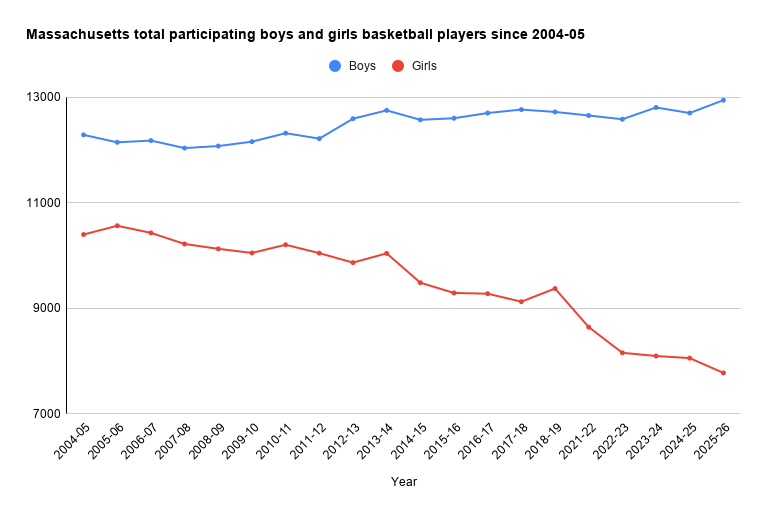
Girls basketball numbers in the state have declined 16 times year-over-year in the last 19 measured years (2019-20 and 2020-21 were not recorded due to the pandemic).
It's now time to ask: Why? The answer is layered.
What are the top girls sports today?
I posted some of the above stats and notes on Twitter/X, and a handful of commenters quickly went to volleyball's rapid rise as a culprit. And though correlation does not equal causation, there's certainly a pattern.
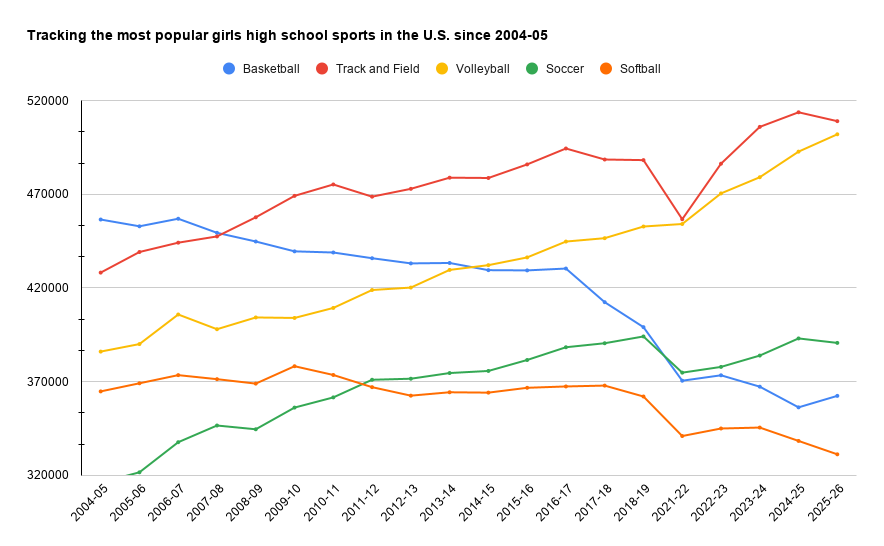
Basketball has plummeted specifically since 2017. Softball has also started falling off. Soccer and track have rebounded nicely since the pandemic.
But volleyball is on a rocket ship. By next summer's NFHS survey, it could be the new most popular girls high school sport in the country. In fact, many NBA players are seeing their daughters flourish on the volleyball court, as ESPN's Aishwarya Kumar recently unpacked.
I hesitate to directly link volleyball's ascendance to basketball's decline. The school seasons don't overlap seasonally and it's not uncommon for basketball players (like Harvard starter Abigail Wright, from Newton, Mass.) to spike volleyballs in the fall. However, these sports are demanding more and more of athletes' time, with the club volleyball scene also wildly popular like in grassroots basketball. I'm speculating, but I wonder if volleyball's increasing popularity coupled with the funnel of single-sport specialization has knocked basketball down the ladder. We'll see if the most recent year-over-year rise in hoops is an outlier or a positive signal.
What are girls playing here?
It's important to note that New England is a unique region in terms of the diversity of sport offering. Consider the ten most popular girls sports in the country, in order: outdoor track and field, volleyball, soccer, basketball, softball, competitive spirit (cheer), tennis, cross country, swimming and diving, and flag football.
New England's own leaderboard looks wildly different as shown below. I stole this screenshot from the NFHS survey data dashboard (I highly recommend playing around with this to answer more of your own questions).
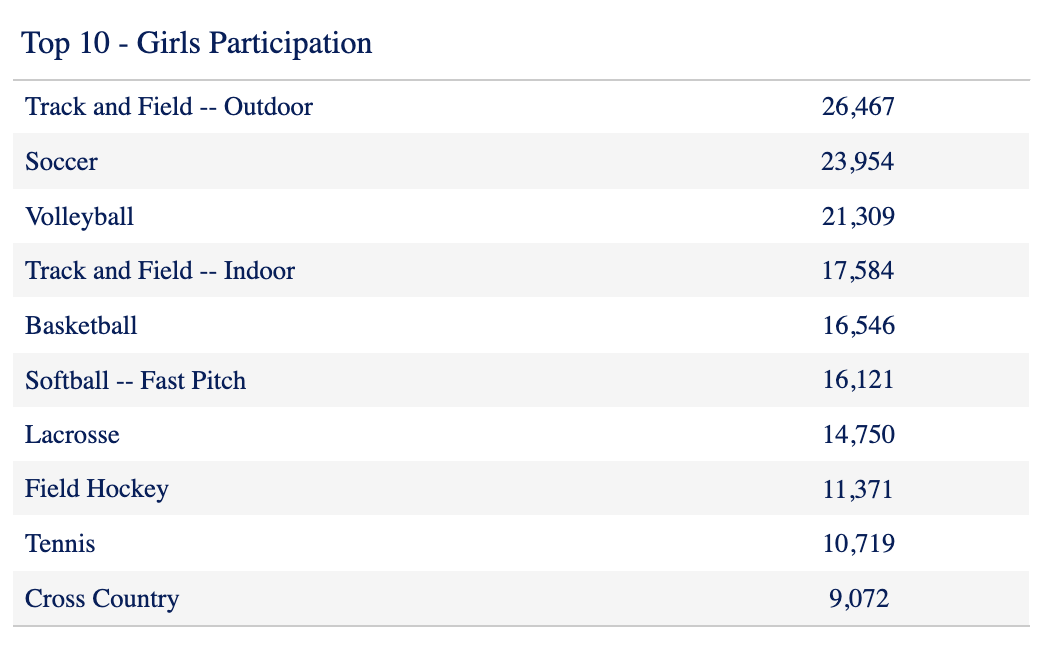
Indoor track is its own category up here in the Northeast, where it gets cold. Volleyball doesn't have quite the same reach, but soccer remains popular. Massachusetts on its own has the third-largest field hockey population in the country while Texas reported zero state-sanctioned high school field hockey players. It's also one of only two states, joining Minnesota, who reported more than 1,000 girls ice hockey participants.
Massachusetts also reported zero competitive spirit athletes. This does open up another minor issue with this data; club-level or independent programs, like the many cheer programs that do still exist here, are not counted.
Other sports are conversely left behind. Flag football and girls wrestling remain on the fringes here (though I would watch those spaces for growth). The point is that still, New England has so many viable options, particularly in team sports, for high school girls. It's not that fewer girls are playing sports here; the trends in totality show most New England states have rebounded from the pandemic-induced dip. It's just that the competition for athletes is its own battle.
What about prep school recruiting?
Importantly, the data only accounts for athletes under each state's high school association umbrella. That means no NEPSAC or other prep schools are included here. So could that explain the falling numbers in girls basketball?
Probably a bit. It's hard to take a stand on this without NEPSAC's own data. But just on speculation, I'm skeptical. Most New England prep schools have existed for a long time and many had girls basketball teams, even if the caliber of those teams has skyrocketed in the 21st century. How many new prep school teams are there? Does that explain a decrease of roughly 2,800 high school players in New England since 2018-19? If a prep school varsity team contains roughly 12 players on average, that would mean about 230 new teams would have come into existence in the last eight years.
Why aren't we seeing boys participation numbers follow a similar trend? Moreover, even as prep schools do build out new programs and recruit the top talent from New England (and beyond), wouldn't high schools just replace them with sub-varsity players, girls who were cut or new freshmen? The notion that they haven't would just take you back to the same central point: fewer girls are opting to play high school basketball.
My hypothesis
The answer is probably a mix of all of the above, plus randomness and elements we haven't explored yet. I do believe that the rise of club sports and single-sport specialization, particularly at the high school level, has forced athletes to pick more often by this age. With volleyball's stock soaring, plus plenty of other established sports in New England, it makes sense that girls are being drawn elsewhere. And yes, to a small degree, prep schools are pulling girls from the measured population.
Can the trend be reversed? That's up for debate — but it starts with making basketball more appealing to the masses of young girls. Maybe the surging professional and college interest will help, but we'll have to wait to see the lasting effects.