


As boys basketball prospects all over New England chase their dreams, they have great examples of inspiration at the highest level of the sport.
In the NBA, there are many players who once played in their backyards and schools. As of August, there are 17 active NBA players who are either natives of New England or attended prep schools in the region. Most recently, that number includes this year’s No. 1 overall pick, AJ Dybantsa, and last year’s No. 1 pick, Cooper Flagg, who was named the NBA’s Rookie of the Year.
Reaching the NBA, of course, is an incredible accomplishment and the odds are unlikely. But all of these NBA players once played on the same courts and played on the same school and grassroots team that many of today’s prospects are now. They were once in their shoes, and they know what it takes to get to the next level from their humble beginnings in New England.
We caught up with a handful of active professional players – including Pat Connaughton, Georges Niang, Terance Mann and Duncan Robinson – from New England. Our conversations centered around a variety of topics about their grassroots experiences and what they learned from a young age.
Here’s Part 1, featuring the pieces of advice today’s NBA players from New England would give to today’s prospects.
While several of today’s NBA players from the region, like Dybantsa and Flagg, were blue-chip recruits who were the top of their high school classes for years and undoubtedly heading on an NBA track, there are even more who were late bloomers.
When Georges Niang (Methuen, Mass.) first got to Tilton in the late 2000s, he was unsure what the future held. He ultimately became Tilton’s all-time leading scorer, a NEPSAC champion and part of some of the best teams in recent New England history – alongside Nerlens Noel at both Tilton and BABC – before earning a consensus Top 100-ranked recruit. But it all started with smaller goals.
“Like when I first got to prep school, I was like, ‘oh, how can I start on my high school team?’” said Niang, who was drafted to the NBA in 2016 and has played nine seasons in the league. “Then, when I started, I was like, ‘how can I be a scholarship athlete, right?’ And I'm in the NBA now, but I didn't have my first Division 1 offer until I was late in my junior year.”
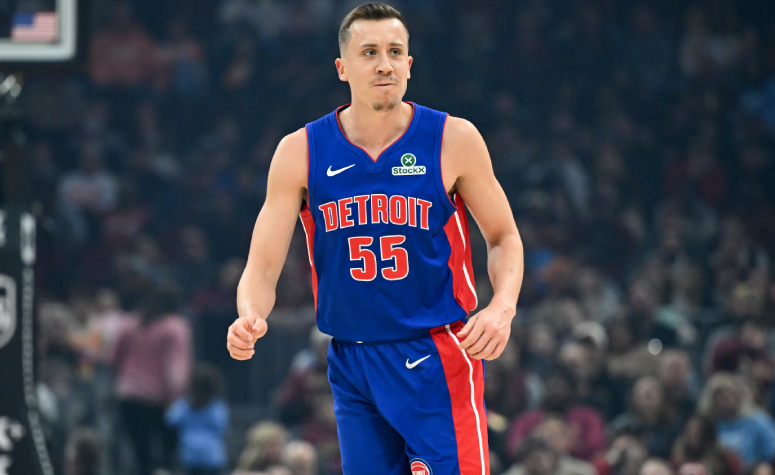
Duncan Robinson’s (New Castle, N.H.) path to the league was famously winding. Long before he became one of the best 3-point shooters in recent NBA history, he was a lightly recruited prospect in his time with Governor’s Academy, Middlesex Magic and a postgraduate season at Phillips Exeter.
Then, the NBA wasn’t close to his radar. Robinson, who had a late growth spurt, struggled to earn consistent playing time early in high school career. By the time he was a senior, he was simply doing all he could do to just land a college basketball opportunity. He got that at Division 3 Williams, where he was a standout freshman who helped the Ephs reach the national championship game. He earned attention from Michigan, and the rest is history.
“I would just encourage younger kids, don’t take the opportunity in front of you for granted,” said Robinson, who has now spent eight seasons in the NBA and plays for the Detroit Pistons. “The best way you can do that is just maximize every single day, and not try to forecast a scenario or a route to get to where you want to go, but really just leaning in to where you are. Playing in the NEPSAC and playing high school basketball around here, it’s such a special community and that’s something, sometimes you don’t fully recognize that until you have a little more perspective in life, how fun that is to play with your best friends and get the opportunity to compete at a really high level and play meaningful basketball.
“I think now, especially in this current landscape of players getting paid in college, it can become about different things and in some cases, the wrong things. There’s a purity of that level, that more likely than not, that will be the last opportunity you really get to experience that. I’m not saying the game still isn’t great at other levels, but it just shifts. It changes a little bit.”
It’s never been harder to earn a Division 1 scholarship than now in the age of the transfer portal, and that has created a trickle-down effect to the other levels of college basketball, too. Robinson knows that. In many ways, he’s the prime example of how you can achieve your basketball dreams from the Division 3 level. Fifteen years later, it’s even more true.
“I’m a huge proponent of that level,” Robinson said. “I tell people all the time, I wasn’t the best player on my team at Williams. There was a senior All-American, Mike Mayer, who was our best player. I might have been the best prospect, but I wasn’t the best player. …
“The level is what it is. People can play at all different levels. The cool thing about the game is it’s as much of a meritocracy as we have, competitive sports. If you can play, then you’ll continue to play. You can play beyond, whether you play Division 3, Division 2, Division 1, high major, low major, whatever, there’s always opportunity for people who love the game and can do it at a high level.”
Pat Connaughton (Arlington, Mass.) has spent 11 seasons in the NBA, including 10 with the Milwaukee Bucks and the 2021 championship, and there was a point when that probably seemed far-fetched. Most of that was because it seemed more realistic he would go pro in baseball; he was drafted by the Baltimore Orioles in the 2014 MLB Draft, but the former St. John’s Prep star ultimately went the basketball route after a stock-rising grassroots season with the Middlesex Magic.
Connaughton regularly comes back to visit Magic practices during summer periods he has time off, and he talks to them about the importance of goal-setting, among other things. Like Robinson, he didn’t get caught up with long-term projections.
“It's just always refreshing to come back and see this next generation of aspiring student athletes as a whole, especially the basketball players, because I was once in their shoes,” Connaughton said. “And it wasn't, hey, Pat Connaughton is going to be in the NBA. It was more likely Pat Connaughton’s going to be in the MLB, and even before that, it was more likely, oh, Pat Connaughton’s a good high school athlete, but I don't know what he's going to do after that, right? …
“I think it kind of shows them that while some of your goals may be lofty, some of your goals may seem out of reach. That's only because they're not imminent goals. They're long-term goals, right? You got to focus on what you got to do on a day-to-day basis, put yourself in the best position in the long run to achieve those things, and even if they're far-fetched, they were far-fetched for me and I've been fortunate to get there.”
Connaughton, who graduated from St. John’s Prep in 2011, went to high school when the landscape was different than it is now. Heading to a prep school, from his perspective, was looked at mostly as an idea to do a postgraduate year and get an extra year of development and strength in order to find a college opportunity. He was an elite three-sport athlete, which is becoming rarer today, and found plenty of high-level competition staying in the MIAA, and he got the coaching and experiences he felt he needed.
“It was a great place to put myself in positions where I was getting boxed in one, triangled and two. I couldn't get frustrated. I had to figure it out,” Connaughton said. I'd figure out a way to make my teammates better around me so that they couldn't do those things. Then came AAU basketball. Yeah, there was better competition because it's select teams and things like that, but I had so much work to that point going against things that I saw, it made the game easier.
“Practices in high school were hard as hell. Games were hard for me and I think it made it easier for me come springtime.”
Even today, when most prospects head to prep schools for a greater challenge, the experience of staying at a public school and developing as a No. 1 option like Connaughton was can be valuable. Connaughton understands that prospects need to do what’s best for them, but the experience still carried weight for helping him figure out how to deal with adversity.
“The biggest thing is probably just the confidence to know I can compete at any level,” Connaughton said. “Because when you're 15, 16, 17 years old, like, yeah, on your good days, you believe you can compete with anybody. But everyone who plays sports knows every day is not a good day. … And what really sets you apart is when you're going through adversity when you're not on a good day, not having a good day, how do you keep that self-belief? How do you toe that line of self-belief, but still being humbled?”
Something the NBA players agreed on? Don’t compare yourself to your peers.
That’s, obviously, easier said than done in 2026. Rankings and social media highlights dominate the landscape and conversation. Those in the league say it’s critical to focus on the work.
“I just learned at an early age not to look at the next guy next to me and try to be like him,” said Terance Mann (Lowell, Mass.), a former Tilton and BABC standout who now plays with the Brooklyn Nets. “I knew what I wasn't good at and what I knew I was good at. I played to my strengths and I worked on the stuff that I wasn't good at. I didn’t really care that the next guy had handles and could shoot, I didn't want to be like that. I wanted to be my own player.”
Niang echoed Robinson’s sentiment about soaking in the experiences and opportunities that come, whether it’s at the prep school or grassroots level. He said those who keep their focus on what matters will ultimately be rewarded.
“Enjoy that process, enjoy that journey, don't get caught up in who's ranked this, who's ranked that because I didn't get ranked until my senior year of high school and all the guys that are ahead of me aren't playing basketball anymore,” Niang said. “I guess just don't get lost in the glory of where you're ranked and what people think of you, just attack every day and try to become the best version of you because if you're good enough, they're going to find you.
“The higher up you get, whether it's NIL money, I never got to experience that, but (whether it’s) professional, AAU, you always have to remember basketball is what got you here, so don't ever think that because you have a little money, a little fame, that these other things are more important than basketball. At the end of the day, basketball is the main objective
“As long as you can focus on that and continue to grind and work hard, I think the sky's the limit for anybody. I've seen kids that I'm like, ‘Oh, that kid's not going to be that good,’ and turn into a pretty good professional. So, anything's possible. I think at this age, in high school, don't worry about how good you are. Just show up and keep working because at the end of the day, some people are going to stop showing up and you're going to keep showing up and you’ll pass them.”