

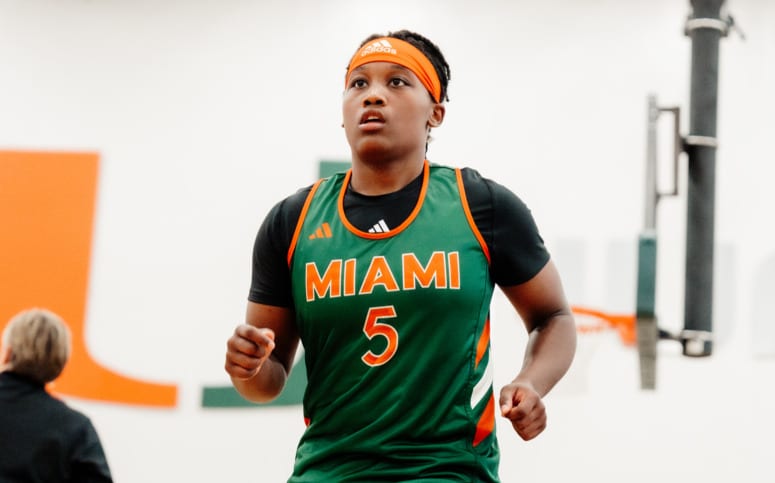

Ahnay Adams wears No. 5 to honor 5 Morgan Terrace.
The address for her grandmother’s house is two blocks from Monte’s Park. It’s a grassy square in the middle of the South End in New Bedford, Mass., with two basketball courts that Adams frequented growing up. Monte’s Park is also known as a spot that attracts gang activity and violence.
Adams donned No. 5 throughout her prep school career at Tilton, where she won three New Hampshire Gatorade Player of the Year awards and emerged as New England’s top 2024 prospect. She still wears No. 5 to start her freshman year at the University of Miami.
Few know the full significance of that number. Adams long hid the realities of her journey from New Bedford to elite college basketball: the strained family relationships, the gunshots she avoided, the times her career almost never happened.
“These past couple years, I never used to talk about it. I used to act like I was rich and (expletive). Now I just embrace it. I’m tough,” she said. “Kids on my team, they don’t come from that (expletive). … I think that’s what separates me and makes me different.”
Adams is ready to share her story. It’s intertwined with the stories of her mother, Tysha Gordon, and her aunt, Lisa Mello-Frost. The three women, all present when Adams committed to Miami on her official visit, have beaten the odds in their respective lives.
“She's kind of like my inspiration, because I look at her and I'm just like: Every card that was dealt to you, not through your choice, but through your parents' choices — which have a secondary effect in that your children are affected by the choices that you make or don't make — she rose above,” Gordon said.
Gordon grew up in New Bedford surrounded by her extended family. Her grandmother lived in a three-decker tenement across from the projects, and her great-grandmother lived downstairs. Gordon’s grandfather was a lieutenant in the New Bedford police department, and out of their children and 19 grandchildren, Gordon says she was the only one who got involved with the street scene.
Gordon’s father was not present in her life. That created resentment, and it needed an outlet.
“A lot of that was because I was angry, because I didn't understand why everybody had a father and I didn’t,” she said. “So a lot of that was rebelliousness, and because of my family and the way they were designed, the ignorance that I had — it's not accepted anywhere but in the street.”
Gordon would walk up to Monte’s Park and hang around the crowd outside. She saw people selling drugs and violence. Gordon knew she needed to keep her own life moving forward, but she kept herself tied to the appeal of the lifestyle.
“I always was in and out of school, would get the degree, get a certificate, but I never disconnected from the street,” she said.
Gordon married Aaron Adams, who had a criminal record dating back to firearm and drug charges in 2000. In 2007, he was sentenced to 3-5 years in prison for intimidating a court magistrate. Ahnay Adams would not meet her father until she was 4 years old.
“Being with her father for so many years, you get accustomed to living a lifestyle,” Gordon said. “For my children, you can't just get out of the car and lollygag like normal kids would do while your mother's taking the groceries out. So we would be: hurry up, grab the bags. Everything's done in a rush because, I don't know, somebody might try to shoot at (Aaron) while we're trying to get out of the car.”
When Adams fled the chaos in her family, she had two safe places: 5 Morgan Terrace and the basketball court. She would join older brother Jaliq and his friends to play 50 (basically 21, with different scoring rules) at Monte’s Park or the local YMCA.
“I started playing a lot and fell in love with it,” Adams said. “And I noticed they were like, ‘Oh, you're gonna be so good.’ But I'm the only girl, so I thought they were just bull-(expletive) me.”
But they were right. Despite being small, Adams possessed natural power and athleticism. She initially started as a football player; Gordon loved seeing parents react when Adams would take off her helmet and show she was a girl outrunning boys. Brian Rudolph, also a native of New Bedford’s South End, was one of those fans.
Rudolph later became Adams’ fifth-grade health teacher at Carney Academy. He recalls seeing Ahnay come to class with a notebook ready to take notes, something he expected from a high school or college student. Rudolph took on Adams as her basketball trainer. They started at a local YMCA, and when Adams came from St. James-St. John Catholic Middle School, Rudolph tested her by having her practice in her school uniform.
“I would make her work out with, literally, the Sperrys (shoes) on,” he said. “So again, it was another sign, like, ‘Oh, wow, this kid — I'm throwing little challenges at her, and she's accepting every single one.’”
Adams was recruited to join the MCW Starz grassroots program, and they quickly moved her to the Boston-based team that would go on to become one of the best in the country. She trained with Rudolph at Next Level Factory in Dartmouth, but also practiced at the Boys and Girls Club in New Bedford’s West End, with people who could have been at odds with her family.
Gordon noticed that when they were in public and ran into someone who didn’t like their family, she wouldn’t speak at all — but Adams would talk with them and receive respect back. Gordon taught Adams that she didn’t have to live with the same grudges as her mother.
“She literally is a kid that a lot of them say, she has a whole village behind her,” Gordon said. “And that's people that don't necessarily, may not care for her mother and father, but they still show her an abundance of support. They still talk to her regardless of who her parents are — and that's weird, because that's not normally how it is. (Nobody) treated her differently because your mother can be an asshole sometimes — excuse my language — or your father is who he is, you know what I mean? Nobody ever treated her differently.”
But the high-stress lifestyle wore on everyone. Gordon has anxiety “through the roof” and understands it can come off as aggressiveness. The family struggled to put food on the table and pay bills, lived with a consistent paranoia and frequently broke out in disputes.
In December 2017, Gordon and Aaron Adams were in the middle of getting a divorce. Gordon recalls a night when she was sitting at the kitchen table and her daughter suddenly erupted.
“She came downstairs and she was like, ‘What are you gonna do?’ So I look at the clock. I'm like, ‘It's nine o'clock. What do you mean?’” Gordon said.
“I want to go to bed and wake up in peace,” Adams told her. “I don't want to wake up in the middle of the night to you two fighting. I'm sick of this. I'm gonna be all right. My baby brother's gonna be all right. The question is, are you gonna be all right?”
Within two weeks, Gordon, Jaliq, Ahnay and the youngest son, also named Aaron, had moved out of the house. But conflict followed.
When Adams was in seventh grade, Gordon was with a man who had a grudge against Adams' father. A dispute between the two led to shots being fired, and since it happened on the family property, it prompted a police raid that discovered drugs that had been brought into Gordon's house, though not by her.
Gordon didn’t want to snitch, but the police were focused on corroborating their case, so they sought her arrest. The one order: they were to wait until Gordon was not with her children so they did not get wrapped up in the scene.
Gordon dropped Adams off at school, but as she drove the loop home around her neighborhood, she felt something was wrong. She circled a second time, then a third, and overheard a cop mentioning her name into their radio. Gordon then drove back down the road to the main school and pulled over to be arrested.
A commotion ensued outside as teachers came out to see the spectacle. Gordon would not know this until years later, but Adams watched the arrest from her classroom window.
“I just shook my head and went to the bathroom and cried, and then acted like nothing happened,” she said.
During the three days before Adams was supposed to leave for prep school at Tilton, in two separate events, she narrowly avoided getting shot, and later was briefly detained by police.
Gordon was working overnight shifts as a social worker at a local hospital. Adams was out late at night, “hanging with friends where I wasn’t supposed to be hanging,” when gunshots rang out. No one was hit, but she estimated 18-20 shots were fired.
The next night, Adams again went out with friends, unknowingly as they had embarked on a stealing spree. They ran from the cops, but Adams ultimately got taken in.
“At that point I was like, oh sh—, my life's over,” she said. “I just became another story. I was crying.”
The police knew Adams was a talented basketball player — she had just been featured in a local news article — and let her go.
Adams did not want to go to Tilton; she says she purposefully did poorly on her SSAT so that she wouldn’t get in. She and Gordon first wanted to stay at New Bedford High, but Mello-Frost quickly ruled it out.
Mello-Frost, 58, is Gordon’s cousin. The two are more like sisters. Mello-Frost’s parents got married as teenagers and both worked, so she and Gordon often stayed with their grandmother, growing close as children.
Gordon was nonchalant about Adams’ basketball talent, but Mello-Frost saw a budding career and a way out of her current life. Mello-Frost joined Adams on her first AAU trip in third grade. At one point, she laid into Gordon for not understanding basketball’s importance, and they didn’t talk for two weeks (Mello-Frost then wrote a letter apologizing). They reached the understanding that Mello-Frost would be Adams’ “basketball mom.”
A Northfield Mount Hermon alum herself, Mello-Frost pushed for Adams to go to prep school. It came down to two options: Tabor, a short drive from home in Marion, Mass., and Tilton, two hours away in Tilton, N.H. Mello-Frost firmly believed Tilton was the better fit, and she and Gordon agreed to split the tuition costs.
“I always felt it in my heart, just seeing her play, and I wanted her to have the opportunity to be — not scarred by your reality right now,” Mello-Frost said. “We’ve just got to look to the future and keep focused on what's going to happen in the future, and basketball is going to be the way to get there.”
Adams had a rough cultural adjustment ahead, attending a school with less than 300 kids in a town of about 5,000 people, including very few Black women like her.
“I was like, I'm about to be in the boonies, about to be out here with no one,” she said. “I gotta get my (expletive) together. I can start fresh. No one knows me, I don't know anyone, I can start fresh. I'm just gonna go in and just work hard and just do what I gotta do, because I'm here for a reason. I didn't die that night for a reason.”
Tilton coach Tara Brisson and Adams built chemistry quickly. Adams enrolled during the pandemic-altered 2020-21 winter season, when Tilton only played 12 games against Lakes Region opponents and NEPSAC did not have championships.
In one of those games, against Holderness, Brisson saw Adams finally tap into her boundless potential.
“Her shoulders were no longer filled with stress, and she just played the game she loved. I think she finished with, like, 38 points, and she's 14 years old. She was just cooking out there,” Brisson said. “And I remember after the game, putting my hand on her shoulder, and being like, ‘This is what you're capable of in this league. Just let yourself be great. Stop worrying about everything else. You have all of the tools, you have the support system, you have me. You are going to get there. Whatever goal you've written down for yourself, you will achieve it.’”
From that game, Adams’ star went supernova. The 5-foot-6 point guard helped Tilton reach the NEPSAC Class AA finals twice, won Class AA Player of the Year as a senior and finished as the school’s all-time leading scorer with 1,776 points. She reached as high as the mid-30s of ESPN’s national rankings.
Brisson believes Adams might be the toughest player she has ever coached; Mello-Frost called her the most disciplined person she has ever met. Adams woke up at 5 a.m. to get to the gym for ball-handling drills and extra shots. Brisson and Adams bonded because they shared motivation: to silence those who doubted Adams could make it, and to validate those who always knew, like Mello-Frost.
“She and I would always say, yep, we're gonna prove them wrong, and we're gonna prove the people that believe in us right — let's prove them right and prove them wrong,” Brisson said. “That was kind of our mantra that we played with.”
Adams considers Brisson to be almost another mom. She rarely showed emotion to anyone but would enter Brisson’s office and melt down if she was experiencing hardship.
“Me being a Black kid who doesn't have their dad in their life consistently, family struggles financially — during that time, I was going through hell, and she was just right by my side,” Adams said.
Their connection was tested during Adams’ sophomore year.
In early 2022, Mello-Frost suffered a severe brain aneurysm as a result of a genetic condition. Doctors placed Mello-Frost into a medically induced coma for three weeks, and during that time, she suffered multiple strokes.
Meanwhile, Adams and Tilton were making their run to the Class AA finals.
“I know that Lisa wanted her to continue to play, and I knew that it was the best distraction for her, right? Being there by her bedside every single minute was not going to be what was going to get Ahnay through this really hard time,” Brisson said. “She would play, and then she would completely break down. In that 90-minute moment, she would forget that there was this other world around her, and she would just do the thing that she loved. And then she would remember, 'Oh, life is hard, and I'm struggling with something.'”
Mello-Frost came out of the coma paralyzed on her right side. She would recover through nine months of physical therapy. Tilton ultimately lost to Tabor, of all schools, in the championship that year.
“I remember that I was in rehab at the time, and my daughter gave me the phone, and I talked to (Adams) in rehab, and she said, ‘I'm sorry.’ And I'm like, ‘Baby, why are you sorry?’” Mello-Frost said. "She said, ‘Because I wanted to win for you.’”
By the time Adams graduated, she had become an integral member of the Tilton community. She had breakfast every morning with her freshman English teacher, Mike Landroche, and other kids gravitated to them. Adams surprised even her family when she acted and sang as Sebastian for the school play, "The Little Mermaid."
When Gordon let Adams go to Tilton, she worried that being at a prep school surrounded by wealth would sow insecurity in her daughter. But Adams found that her life experiences were worth just as much as those around her.
“That was the best thing for that child, because it allowed her to identify that the only difference between people who have it and people who don't is what they started preparing for at a younger age,” Gordon said.
Now at Miami, Adams is faced with the reality that every teammate and every opponent was also the best player on their hometown team, just like her. She often asks, 'How do I separate myself?' In those moments, she thinks about her own home. Adams still trains with Rudolph, bringing a notebook to their sessions so she can log every workout plan.
“That's why I play so hard, that's why I work so hard, because I come from a blue-collar city,” she said. “Everyone's working hard. Everyone's working their ass off to provide for their families and put food on the table. That's where my pride comes from.”
Adams has also changed her perspective on her family as she’s grown up — including her relationship with her father.
Adams says that her father has not been a consistent presence in her life, but he has recently put himself on a better path. She accepts that Aaron, who also cheered her on way back when she played football, is primarily responsible for instilling that killer mentality inside her. Aaron never sugarcoated anything with Adams and motivated her to prove people wrong. She’s recently been in inconsistent contact with him as they slowly make progress.
“You get two parents. That's it. God forbid something happened, I don't want to be like, 'Damn, I could have had this, this and this from my dad, but I just chose not to because I'm holding grudges,'” Adams said.
Adams said there was a time in her life when she hated Gordon. Now she would do anything for her mom.
Gordon spent a week in jail following her arrest in 2018, seven months wearing an ankle bracelet and three years fighting the charges — all ultimately dismissed.
During Adams’ childhood, Gordon worked overnight shifts as a recovery treatment worker at High Point Hospital, even adding overtime shifts to help make ends meet, before later working for the state. She still pursued and received her master’s degree in mental health counseling from Springfield College, and also got her LADC I (Licensed Alcohol and Drug Counselor). Gordon and hopes to one day start her own private practice.
“I was taking all my anger out on her, constantly fighting and arguing, but now she's my best friend. I tell her everything,” Adams said. “She comes down and she sees me. She makes sure I'm OK, mentally, physically. She provides for me. She never hesitates when I ask her for something, never, and that's why I won't ever hesitate when she asks me for something. I haven't since 16 years old. She's my superhero.”
Gordon recognizes with hindsight how much her traumatic environment impacted her, as well as her children. She goes to Mello-Frost for support and also taps into therapy. But she speaks critically of herself as a parent. Her mindset when raising her children: Don’t be like me.
“She could have never played ball,” Gordon said. “You could have lived the traditional, basic life that most kids live, I just needed you to be different than me, and that meant everything: the way you thought, the way you speak, everything. Just be different than me.”
Rudolph has watched Adams grow up alongside Gordon. He says Gordon doesn’t give herself enough credit for overcoming her mistakes and difficult circumstances.
“There could have been so many times of just giving up… but for her to keep going and take those small wins, those micro-wins — I don't think she sees that 'Nay sees that too,” Rudolph said. “...Her mom works her ass off. She's come a long (expletive) way, excuse my language. That was big in 'Nay seeing that, because 'Nay could easily be like, ‘This is how I grew up. This is just it. This is what it's supposed to be.’ And Tysha didn’t just stay at that standard; she just kept growing.”
Gordon gets emotional talking about their bond now. Adams is her inspiration, because during times when she despaired and her own problems felt hopeless, it was Adams who lifted her and the family out.
“I think for a long time, she knew she carried the family on her back, through her strength, just through the way that she would see things,” Gordon said. "She would often say to me, ‘I hear you talking about the problem. We know the problem. I have yet to hear the solution. Ma, what's the solution to that problem?'
“... She's just always been wise beyond her years. Sometimes I joke about it. I'll be like, I don't know whose baby they gave me in the hospital, but I'll keep her.”