

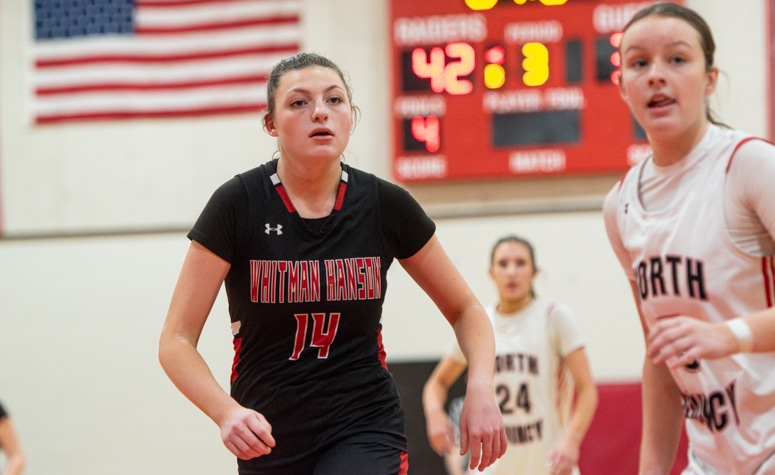

Leah Daley carries two bags of essentials with her on basketball gamedays. One helps her shine as Whitman-Hanson's point guard and senior co-captain: sneakers, water bottle, uniform, etc. The other is for her new responsibilities as a Type 1 diabetic.
That bag contains a finger prick reader to check her blood sugar levels, as well as an insulin pen. Daley loads it up with fruit snacks and adds in candy; Skittles are easiest to count out carbohydrates. She patches onto her upper arm a Dexcom sensor that monitors her blood levels in real time, and she discreetly attaches an insulin pump near her stomach.
At first glance, it's hard to notice a difference. Daley is playing her best basketball ever, averaging 8.6 points, 4.5 rebounds and 3.3 assists on the fourth-ranked Panthers entering Tuesday. She's completing one of the more remarkable career arcs you'll find in high school, going from starting her first game as a freshman to a JV demotion and slowly climbing back to prominence on an MIAA championship contender. Daley is eager to talk about her diabetes. She loathes the idea of it affecting her effort level.
"I really, really hate to use my diabetes as an excuse," she said. "I don't like missing school because of appointments. I don't like doing any of that stuff. It's very aggravating to know that I have an excuse while others don't. I don't enjoy that."
Late last summer, as she started gearing up for volleyball season, Daley noticed she was constantly thirsty and fatigued. She couldn't hold down food and lost about 20 pounds of water weight. She spent an entire volleyball trip in Miami over Labor Day weekend struggling to eat and regularly nauseous. Daley's mom, Tara, took her to get her blood sugar levels checked on Sept. 13 — and they were off-the-charts high.
Type 1 diabetes is familiar territory for the Daley family; Daley's dad Pete was diagnosed 13 years ago. At first, Daley was only mildly concerned, but she soon realized how much room she'd have to make for diabetes management in her daily life. She skipped playing fall AAU because she didn't want to test her conditioning. Volleyball was less of a physical strain — it's not her primary sport and the game itself has more stoppages than basketball.
"She didn't think it was really going to be that big of a deal," Whitman-Hanson coach Michael Costa said. "But then as she kind of actually got into (playing), she was like, 'Oh, wow. This is kind of a big change.'"
The first time Daley pushed her body's limits was during a winter break practice. She had forgotten her second bag of essentials at home — "which never happens anymore," she said — and thought she was fine because her earlier blood levels read normal. But Daley felt sluggish throughout practice and didn't tell her coach. Her vision started blurring, she lost focus, and following an intensive conditioning drill, Daley broke down in tears.
"Her teammates were kind of nervous, and she was a little bit shaky (and) jittery," Costa said. "And I went over, so I'm like, 'Hey, you're all right.' And she's like, 'No, I'm low. I'm an idiot. I should have grabbed a drink before this, but I thought I was OK.' And she got really upset and emotional."
Daley's panic was a mix of physical turmoil and overwhelming mental pressure. Later that night, she texted Costa with a profuse apology for disrupting practice and not taking care of herself.
"I'm like, 'Listen, you're still getting used to this. It literally happened two months ago that you were diagnosed with this,'" Costa said. "'Just relax. It's not your fault. You're just figuring it out.'"
Costa must carefully monitor Daley's playing time despite valuing her highly as the Panthers' starting point guard. And Daley has to be honest with Costa about when she needs a sub. It requires a new dimension of trust — which has already tested their coach-player relationship before.
Daley impressed Costa immediately as a freshman, so much so that she started her first high school game. It didn't go well. Daley admits she was "scared" to play, and felt like whenever she took the floor, she had to show Costa she was worthy of her elevated role. She kept struggling, then got sick, and when she returned, Costa had not only benched her, but put her on the junior varsity team.
"I felt like it was my fault. I shouldn't have started her as a freshman, game 1, because that's setting her up for failure," Costa said. "I felt like I had taken her confidence away by A, doing that, but then B, putting her on JV, because she never really got right that freshman year."
Daley was shaken.
"Obviously, I'm gonna say, 'OK, yeah totally, that's not that big of deal.' But realistically, it was very surprising," she said. "I was definitely feeling a bit upset — not about him putting me down to JV, but the fact that I wasn't playing how I really do play. And so I think that kind of ruined my confidence, a little bit, just being like, 'Oh, I just started as a freshman. Now everyone knows I moved down to play JV.'"
Daley didn't feel connected to the team as a freshman. She spent sophomore year as a fearful reserve. Daley and Costa talked often about how well she would play in practice and how it rarely translated to games.
"I think I was just so nervous the whole time being like, 'Oh my God, he hates me. I can't go in — even though I knew he didn't hate me,'" she said. "If I mess up, I feel like I'm just gonna be out. So that was very hard for me. I feel like I didn't have fun at all my sophomore year. I was so focused on, why am I not playing good?"
But something changed junior year. Whitman-Hanson point guard Lily MacKinnon tore her ACL. Costa went to Daley and offered her the spot. But it came with more: a vote of confidence.
"I'm like, 'If you want, it's yours. But just understand that I have the utmost confidence in you to do this, or else I wouldn't be asking you to do it,'" Costa said. "'I know it's not going to be the prettiest thing. There's going to be peaks and valleys, and there's going to be turnovers, and you're going to be learning on the job, but just know that I'm the one that's basically doing this. So if you're making mistakes, it's not on you. It's on me, it's on us, and we'll fix it together."
Daley averaged 7.8 points as a junior and steadily improved over the winter. She made the Spartan Classic All-Tournament team, then scored 24 points in Whitman-Hanson's first-round state tournament win against Middleboro and contributed to the Panthers' Division 2 semifinal run. Along the way, Daley's vocal leadership emerged. She could relate to just about every role in the program, from JV player to varsity starter. No one was surprised when the team voted her a senior captain.
"I think when times get hard during games, you can tell on everyone's face, something switches up. But when that happens with Leah, she might have a little upset face, but she can snap out of it so fast," said Dylan Hurley, one of the Panthers' stars and a lifelong friend of Daley. "Not a lot of people can do that — I'm not the best at it — but she's really good at snapping out of something quick and picking each other up."
Captainship completed the growth of Daley's dynamic with Costa. Now Costa has to keep an eye out for when Daley chucks her Dexcom to the bench mid-play because it's not working. She started the winter with her insulin pump on her lower back but learned the hard way that falling on it (after trying to draw a charge) is seriously painful. It also meant her pump leaked insulin everywhere, and Daley's health insurance can only replace a limited amount. Senior year is supposed to be the capstone for Daley's nonlinear career arc, since she doesn't plan on playing in college. Instead, diabetes has changed the storyline — and strengthened an already-strong bond with her father.
Pete coached Daley and several of the current Panthers in youth leagues. Both received their Type 1 diabetes diagnoses atypically late (Pete was 32 when diagnosed). When the Panthers needed a parent or nurse to accompany Daley on their winter break trip to California, Pete stepped in. Daley credits his attitude as a consistent "problem-fixer" for keeping her spirits high as she adjusts to life with the condition.
"I didn't feel lucky at first. I was like, 'What the hell is this? Why me?' And now I know I actually am lucky to have it, and I'm very grateful that I have the people like my mom and my dad to help get through. If I ever need a question — like, how many carbs are in this? — he always just tells me. I truly don't know what I would do without him."
Daley says her For You page on TikTok is now filled with diabetes-related content. She loves learning about how others are taking on the disease. She can better empathize with her friends who have Celiac disease. And as she finishes out her final basketball season, Daley hopes viewers focus on her on-court skills before they notice what she's carrying.
"You could be the same person you've always been, with diabetes," Daley said. "It hasn't changed anything about me except that I have an autoimmune disease. People shouldn't be looked at differently because they have devices on their body."