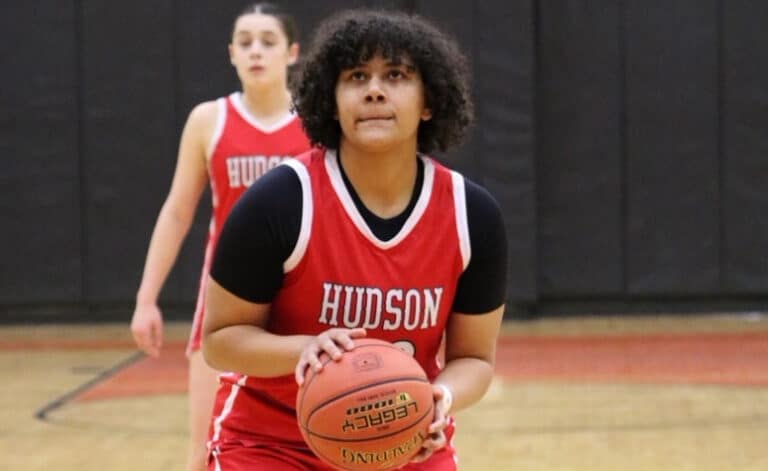
Hudson, Mass., girls basketball coach Marty Murphy was attending a Hawks soccer game in September when he saw Kristina Bruce for the first time post-car accident.
Murphy watched Bruce, who he had always known as a talented two-sport athlete, struggle to get out of her mom's car and use her crutches. He told Bruce she looked like she was recovering well and joked with her about having a race. Inside, Murphy was shattered.
"Literally, it broke my heart," he said.
Ask those close to Bruce, like her mom Heather, her best friend Makenna McGuire and Murphy, and they're still in some stage of disbelief that Bruce is playing significant minutes for the Hawks. Heather and McGuire saw Bruce's life hang by a thread at Mass General Hospital, where she spent six days in critical condition following the crash. Murphy and the Hudson coaching staff watched Bruce fight through physical and mental walls in her recovery as she learned to walk, run and hoop again.
Bruce improbably returned from a broken right femur, pelvis, hip and rib, a collapsed lung and torn tendons in her left hand, plus significant cuts and lacerations, to play her first game of the season Jan. 10 — less than five months after her life-threatening accident.
“She's had this complete transformation that I'm just astounded by," McGuire said. "She's one of the strongest people I've ever met.”
On Aug. 14, Bruce got behind the wheel of her family's white Jeep Cherokee to drive to her summer job at Roche Bros. Supermarkets in Acton. At the time, she was preparing for her junior year at Concord Academy. She had transferred last year from Hudson and enjoyed a solid first season in NEPSAC, earning Eastern Independent League All-Star honors. On the soccer field, Bruce earned a reputation as a steady goalkeeper. But she more naturally gravitates to the hardwood; Bruce loves South Carolina and her favorite player is former Gamecock and Worcester Academy star Aliyah Boston.
Bruce was feeling sick — "not like myself" — that morning, but she wanted the gas money. She doesn't remember the actual crash, but at some point on her drive she blacked out (that would later be attributed to a bad side effect from an anti-anxiety medication). Bruce's car smashed into a tree and caught on fire.
She recalls fragments of the immediate aftermath. A woman helped pull her from the wreckage. Bruce spoke with police officers who told her she would be getting LifeFlighted to a hospital. She doesn't remember much of the helicopter ride.
Heather, a clinical director, was at a training session with other area clinical directors in New Hampshire. She started receiving a string of phone calls from Acton and ignored them, assuming it was spam. One left a voicemail that told Heather a car she owned had been in an accident. At first, Heather worried Kristina had been texting while driving and rear-ended someone. Then when she called the police back, they explained it was much worse and that they'd update her soon.
"They didn't after 20 minutes, 15 maybe. And I'm a nurse myself, and so normally when that happens, that is sometimes indicative of something fatal," Heather said. "So I had to wait, and it seemed like forever."
Once Heather found out Bruce was headed to Mass General, her sister Julie McGowan picked her up, and they got to Boston 45 minutes later. Fortunately they had another extended family member, Sean McGowan, working at Mass General, who could be near Bruce and provide updates.
Meanwhile, McGuire was at home in Hudson when the news arrived. She could hear her mom's distress while listening to the call from Heather, and when she relayed it to McGuire, McGuire broke down in tears. She had to meet a friend for lunch, and her mom insisted she go. But McGuire couldn't make it through, and she and her mom quickly left for Mass General.
McGuire and Bruce have been best friends since preschool. They played soccer together, and even when Bruce transferred to Concord Academy, they stayed in close touch. McGuire arrived to see Bruce in the trauma center with her neck in a cervical collar. As Bruce moved from room to room, she told McGuire what happened. McGuire did her best not to cry when Bruce screamed in pain and entered operating rooms alone.
"I was very shook up and scared and stressed to see her in that condition," McGuire said. "Her leg and her face — she had scratches everywhere, bruises everywhere. She had the neck thing on and it was just a very scary environment. I'm not good with hospitals and people getting hurt or sick or anything, but it was just very, very hard."
Bruce's right leg was "severely deformed" and first had to be put in traction to get it re-angled properly. She explained that her family had to leave the room as doctors jabbed a needle in to numb her leg, drilled through it, inserted a metal rod into her shin, lifted her leg up and then used weights to bring it down correctly. Bruce was awake for the entire procedure.
"I don't think I had too much time to really process it," she said. "I mean, there was a lot of adrenaline and stuff. And then they had me on meds to help – like, a lot of meds."
The next day, Bruce underwent an 11-hour surgery. It included multiple blood transfusions; blood loss was the primary concern that placed Bruce in critical condition. Heather and her family waited, and waited, and waited in the family room. Each surgeon would give Bruce a call when their portion of the procedure was complete.
"I started to feel confident, and then I had ups and downs," Heather said. "You're thinking, OK, she's had, you know, six units (of blood transfusion) at this point, her levels should come up. And then when they're coming back in and saying, 'I'm sorry they're not,' and they're starting IVs over and over to get all this blood into her, it's definitely nerve-wracking because you don't know if she would have ever kind of normalized."
But Bruce made it. After surgery she told the nurses her favorite Chipotle order (Bruce was too deep in anesthesia to remember that). McGuire gave her a journal filled with their favorite memories and inside jokes from a lifetime as best friends. She described to Bruce the great view she had from her hospital room since Bruce couldn't get up to see it.
"You have this child who you think is invincible, right?" Heather said. "She was, a very gifted athlete, strong, really a force to be reckoned with in many ways. And then here she is, very vulnerable and incapacitated, really, and at the time, 16 years old, and not knowing what her future was going to be. She went from being this vibrant young girl who was never home and always at a practice somewhere, to stuck in a hospital bed, and (she) could not even get out of bed without assisted devices."
After six days in critical condition, Bruce moved to a rehab wing in the hospital and then went home. Her accident occurred mere weeks before the start of the school year, so she and Heather made the decision to transfer back to Hudson. Concord Academy's academic rigor had put Bruce ahead of schedule, so she could take a reduced course load in the fall while staying closer to family.
"It was hard to just think about how I have to get integrated back in with everyone else that was there," Bruce said. "I missed a full year, so people move on and stuff. So it was hard for that, and then to know that I couldn't even play a soccer season or the beginning of basketball, before I even went — it was hard."
Heather and Bruce live with Heather's mother and stepfather, but that's the extent of her small family household. Heather was overwhelmed by the support they received from the community. Connections from both Bruce's current New England Panthers AAU team and her former Mass Huskies team, along with friends in town, brought meals and gift cards. One basketball friend created a GoFundMe page that has raised more than $15,000.
Bruce had to stay in a hospital bed in her living room because she couldn't make it upstairs. She also needed a shower chair, and Heather had to bathe her and take care of most daily tasks at first. Bruce would attend school in-person about once or twice a week, going from class to class by wheelchair. Her leg would swell up and Bruce would try to manage the problem before going home and getting back in bed.
She spent 10 weeks in outpatient therapy before she could start putting weight on her leg. The most painful injury was the broken femur, but her broken hip and pelvis kept her from walking. Instead of playing soccer, Bruce became a team manager. Even that was a challenge since she couldn't get to the field without a wheelchair or golf cart. Standing for long periods was bad for her leg and sitting hurt.
While Bruce's classmates met up at Friday night football games, Bruce had her mom or McGuire wheel her around at the mall or the movies. McGuire often came over just to watch a movie with Bruce or listen to music together.
"She would have a day of, like, 'Oh, I feel encouraged,' and then days of just, 'This is just never going to get better,' or, 'I'm working hard, but I don't see the progress,' and just feeling very overwhelmed and sometimes isolated," Heather said. "... There were definitely difficult times emotionally, and that's where her strength is just unbelievable."
In mid-November, Murphy happened to be in the Hudson gym when he saw a glimpse of Bruce. At first he didn't recognize her — no way was the girl he had seen two months earlier now walking all by herself. But it was Bruce, and she strode right up to him.
"She's like, 'Hey Coach, I just got back from the doctor's office, and they said that there's a possibility — I have to go there Jan. 8 — there's a possibility that they might clear me to play basketball this year,'" Murphy recalled. "And I gotta tell you, I'm stunned at this point, because I don't even know if this kid would ever play basketball again."
Bruce had played on Hudson's varsity teams in eighth and ninth grade before transferring to Concord Academy. Murphy knew her as an impact player — but could she ever get it back?
First, Bruce had to run. She took slow, laborious jogs around the track that encircled the gym balcony, or jogged off to the side while the rest of the Hawks practiced.
"I feel like I've never done this before. I feel like I'm trying to teach myself how to run again," she told Murphy and assistant Laura Bowen.
Then Bruce progressed to non-contact basketball work. Murphy saw her shooting touch and footwork return quickly, and the challenge became rebuilding stamina and fitness. On Jan. 8, Bruce and Heather went back to Mass General and received the much-anticipated all-clear.
"I said, 'You understand how this girl plays basketball, right? There is no stop for her; she is going to go full-on,'" Heather said. "And they all looked at me and said, 'Mom, she's cleared. Take a breath. She's cleared.'"
Two days later was Bruce's first game. She knew she wouldn't play in the first quarter but anxiously waited on the bench. Heather had brought the extended family to watch. McGuire was in the stands too, holding a poster that read, "No. 32 on the court, No. 1 in my heart." Bruce said she had never been so nervous for a game in her life. She didn't want to look at the crowd because she knew she'd get emotional.
The public address announcer called Bruce in to start the second quarter. Murphy said he got goosebumps and started to tear up watching her take the floor. She pretty quickly scored her first bucket on an open fast-break layup.
"I think my heart rate was probably 130 when she first stepped on the court, if not higher, and it was just because I knew she was going to go full-on," Heather said. "She scored her first basket, and I think there wasn't a dry eye in the bleachers."
The recovery journey is not complete. Bruce's minutes have increased as weeks pass, but she still comes off the bench. She scored 14 points in a 47-44 win against Maynard Jan. 21, but her consistency isn't there yet. Heather notices her daughter's gait change as she runs up the court. Murphy warily watches her in full-contact practices. Bruce has taken a couple of hard falls in games, putting everyone on high alert before she pops back up to keep battling.
Bruce is not the same player she was – nor is she the same person. She and Heather characterized their pre-accident relationship as loving but filled with the typical mother-daughter clashes. Now their mutual admiration has changed them both.
"It's so hard to have to take care of someone. She had to feed me, bathe me, change me, like, everything, like, especially in the beginning," Bruce said. "And she's a nurse, so she has to do that anyways on the regular, but she did it even at home. It was just crazy to me how someone could be so strong."
Bruce and McGuire say they're even closer as friends. And Bruce has a newfound appreciation for doctors and hospital workers. She credited one Mass General nurse, Jackie Ruggiero, for lifting Bruce's spirits with jokes and conversation while she was in critical condition. Ruggiero was the first person Bruce went to see when she got cleared, and the family still visits and eats Panera with her on occasion.
"Honestly, they were some of the most impactful people, — like, impactful in my life — types of people I've ever met," Bruce said. "She's helped shape my future, I would say, just by helping me and influencing me to do something to help people in the future."
McGuire and Heather say Bruce's general mood is much happier with basketball back in her life. Bruce still has ambitions for herself on the court, and recapturing that standard can be frustrating. But she suits up and plays regardless.
"This is my child back. This is her this is her happiness. This is her wheelhouse," Heather said. "This is what she was striving for since August, and just the fact that she was able to do it, and she's here — (I'm) just trying to get her to understand that maybe it's not going to be like it was a year ago, because you're a different person.
"But that's a good thing, because you've grown. You've survived through something that most people couldn't. Basketball aside, look at what you've done."